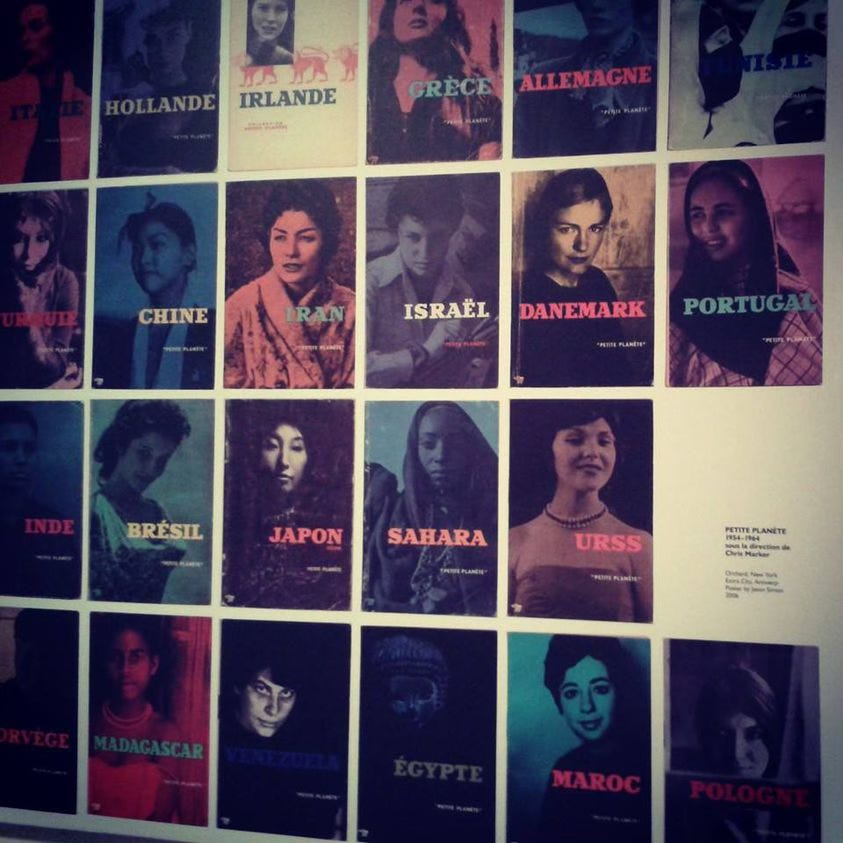
Chris Marker’s Petite Planète exhibition in London, Whitechapel Gallery
“A little bit of light dispels a lot of darkness.”
—Chabad.org
Somewhere along Federal Highway, between the nail salons and the bodegas, between the casinos and the synagogues, between the Publix with its Russian-language aisle and the park where men play chess on Saturday mornings, there are large, bright apartment buildings in which the old world has never quite ended. It turns out it never needed to.
Here, in Hallandale Beach and Hollywood, Florida, people are coexisting between a living room and a shared hallway, between a balcony sale and a folding table in a parking garage. The Soviet kollektivnost, the communal obligation, did not vanish when they crossed the ocean. It shape-shifted. It put on a price tag. And somewhere in the process of becoming American, it also became something almost ancient: a version of Jewish communal life that their grandparents, in the shtetlekh of Ukraine and Belarus, would have recognized immediately.
8finite Stories is a reader-supported publication. To receive new posts and support my work, consider becoming a free or paid subscriber.
What they built here, in these Florida corridors, is not a relic. It is a living thing. It is, in fact, the future.
The Architecture of Belonging
To understand this community, one must understand what it escaped and what it carried. The kommunalka, the Soviet communal apartment, was not a choice. Families were assigned rooms in shared flats by state decree; strangers cooked on shared burners, bathed in shared tubs, raised children in rooms no larger than a generous closet. Privacy was a bourgeois concept. Everything belonged to the collective whether you liked the collective or not.
But underneath that imposed collectivism, something older persisted: the Jewish understanding that a person is not complete in isolation. The Hebrew concept of kehilla, community, is not a sentiment but a structure. It is the minyan, the ten people required for prayer, that makes certain acts of worship possible at all. It is the hevra kadisha, the burial society, organized not around grief but around obligation. It is tzedakah, often translated as charity, though it more precisely means justice, which frames giving not as generosity but as duty. These were not ideas the Soviet state could stamp out. They went underground. They survived in kitchens. They arrived in Florida intact.
The people who came to South Florida in the 1990s and 2000s, from Odessa, from Minsk, from Leningrad-becoming-St. Petersburg, from Kharkov and Dnipro and Kyiv, carried that architecture in their bodies. They knew how to share a wall. They knew how to negotiate a kitchen. They knew that survival was collective even when ideology was not. What they did not know, not at first, was capitalism. So they invented their own version: warm, chaotic, slightly irregular, deeply effective. And deeply, recognizably, Jewish.
The Economy of the Corridor
In Hallandale Beach, the buildings are not assigned. You choose your building, your floor, your proximity to the pool. But the old gravitational pull reasserts itself: the Odessans cluster by building, the Muscovites by block, the Georgians by synagogue. Within a year of moving in, a floor becomes a village. Within two years, the village has an economy.
These corridors are decorated with transaction: plastic folding tables bearing Tupperware containers of pickled herring, amber jars of homemade compote, hand-labeled bags of dried mushrooms from a cousin who still summers in the Catskills. A hand-written sign in Russian and English, taped to a cinder block wall, advertises alterations. Another announces reflexology. The hallway is a market. The stairwell smells of dill.
At the center of one such building stands Sofiya Berkman. Grey-streaked hair pulled back, earrings the size of small chandeliers, a voice that carries clean through two closed doors. Sofiya speaks of her life with a pragmatism that sounds almost like philosophy. She recounts her forty years: the music conservatory in Kharkov, the immigration in 1997, the years cleaning houses in Aventura before she discovered what she actually had to sell.
What she had was time, skill, and neighbors. She began by altering clothes for the women on her floor. Then a neighbor’s daughter asked if she could teach her daughter piano. Then someone else needed help writing a letter to the Social Security office, and Sofiya’s son, who had studied English at night school until he dreamed in it, became the building’s unofficial translator. Now the ground floor storage room is a sewing studio. The hallway outside apartment 7B is a weekly market. The pool deck on Sunday mornings resembles a trade fair, if the trade fair also involved three competing opinions on the correct way to make forshmak.
This is free-market communal living: the spatial logic of the kommunalka married to the entrepreneurial hunger of the immigrant and the ethical spine of Jewish tradition. Shared walls become shared opportunity. The hallway is no longer merely a passage from one private space to another. It is infrastructure, held together not by decree but by something much stronger.
The Hair Salon on the Second Floor
If the hallway is the market, the hair salon is the confessional.
On the second floor of one building, in what was originally a one-bedroom apartment, Roza has been cutting and coloring hair for fifteen years. There is no sign outside. There has never needed to be. Her waiting area holds four chairs, a low table stacked with Russian-language magazines, and a framed photograph of Tel Aviv at sunset that a client brought her from a trip and that she accepted with the understanding that it was also a payment for something owed.
Women come to Roza for their hair. They stay for everything else. The salon is where news actually travels in this community: not the news of screens and feeds, but the news that matters. Who is sick. Who needs help. Whose daughter just got engaged. Whose son is struggling. Who arrived last week from Odessa with two children and no winter coat, even though winter in Florida is barely winter at all, and still someone will bring a coat by Tuesday.
Roza does not repeat what she hears. This is understood. The salon operates on the same unspoken code as the confessional, the therapist’s office, the kitchen table at two in the morning: what is said here is held here. But the help that results from what is said here moves freely through the building, through the block, through the network of women who have known each other for twenty years and whose loyalty to one another was forged in the particular heat of people who arrived somewhere foreign and decided, together, to make it home.
There is a younger woman, Natasha, who comes every six weeks without fail. She is in her thirties, arrived from Kyiv in 2022, and speaks of her life with the careful precision of someone still deciding which parts are safe to say out loud. But in Roza’s chair, with the warm water and the familiar smell of the dye and the sound of Russian filling the room like something she had not realized she was missing, she talks. About her mother still in Kyiv. About the adjustment. About the particular loneliness of safety, which is a thing no one outside this room would quite understand.
Roza listens. She does not offer solutions. She offers the bowl of hard candies on the counter and the knowledge that next time, in six weeks, the chair will be there.
This too is infrastructure.
What the Shabbat Table Teaches
On Friday evenings, the buildings change. The smell of Matzo ball chicken soup moves from floor to floor like a tide. Doors that were closed all week open. Neighbors who passed each other with nods in the laundry room sit together at tables set with actual tablecloths, actual candlesticks, the good dishes brought from the old country wrapped in newspaper and carried by hand across the Atlantic.
Not everyone here is observant in the same way, or at all. The community spans the full spectrum, from those who keep strictly kosher to those for whom “Jewish” is more a cultural inheritance than a religious practice. But the Shabbat table has a way of gathering even the secular. It is not about theology. It is about the weekly insistence that there exists a time belonging to no one’s schedule, a table that belongs to everyone, a meal that cannot be rushed.
The blessing over the candles, said by the women of the house, is one of the few moments in Jewish ritual where the prayer is traditionally performed with eyes closed and hands covering the face, drawing the light inward before sharing it outward. The women of these buildings know this gesture. They learned it from their mothers and grandmothers in apartments where the state officially disapproved of religion, where the Shabbat candles were lit quietly, the curtains drawn, the Hebrew spoken low. That it survived is not a small thing. That it now fills a Florida corridor with golden light is, by any measure, a miracle.
The men make Kiddush over wine. The children, some of them already more fluent in English than Russian, repeat the blessing with the mixture of reverence and impatience that is the universal language of children at religious tables. The food is abundant. Abundance, in this tradition, is not ostentation. It is a theological statement: we were slaves, we were hungry, we were afraid. And now look. Now look at this table.
Memory as Inheritance
One afternoon, Sofiya was in a Publix on Hallandale Beach Boulevard when she had a feeling like she was being followed. She turned around. No one was there. She stood near the entrance for a while, just to be sure, and found herself thinking of a particular kitchen in Kharkov, the one on Ulitsa Mironosytska, where four families had shared a single four-burner stove and somehow managed not to kill each other for eleven years.
She went home and took out her photographs. Haunted by former neighbors, she traveled back through images that were yellow-tinged, slightly overexposed, full of faces that did not know they were being documented for the future.
Memory in this community is not nostalgia. It is operational. It is also, in the Jewish tradition, a form of obligation. The Hebrew word zachor, remember, appears in the Torah more than any other command. Remember that you were a stranger. Remember what was done to you. Remember who helped you. This is not sentimentality; it is ethics made structural. The women of these buildings remember which neighbor helped during an illness, who brought food after a surgery, who quietly covered a month’s electric bill and asked nothing about it later. This memory is the ledger of the community. It runs parallel to, and often supersedes, the official economy.
Sofiya came to the United States in 1997. She wore a dark blazer she’d had made in Kharkov, and she carried a jar of her mother’s cherry preserves and a photograph of the Black Sea. The America she encountered was louder than she’d expected and lonelier in ways the loudness could not mask. “In Kharkov,” she says, “even the strangers were not strangers. Here I had to build that from the beginning.”
She built it. They all built it. And the building, the literal building with its ten floors and sixty-four units and one elevator that is always slightly questionable, is the evidence.
The New Arrivals and the Chain of Transmission
Since 2022, new neighbors have come. Ukrainians, displaced by war, arriving with the exhaustion of people who left not for a better life but simply for a living one. The older residents, those who made the same journey thirty years earlier, recognized something in their faces. Not sameness, but kinship. The memory of emergency.
The building mobilized before any organization did. Sofiya’s son began translating for the new families within days of their arrival. Lena and Arkady on the third floor, who had themselves come from Dnipro in 2003 with almost nothing and built a small empire of pelmeni and infused spirits, began delivering food to the new units without being asked. The women on the fifth floor created a clothing exchange in the laundry room. No committee was formed. No one was asked to lead. It simply happened, the way things happen in communities that have internalized, over generations, the idea that a stranger’s need is a community’s responsibility.
This is what the Jewish Russian tradition carries at its center: not a single experience but a method. A way of organizing around obligation rather than convenience, around the long view rather than the immediate transaction. The gemilut hasadim, acts of loving-kindness, are understood in Jewish law as superior even to tzedakah, because they can be given to both the living and the dead, to both the rich and the poor, and they require not money but presence. The women of these buildings are masters of presence.
The older ones teach the younger ones: how to navigate the Florida DMV, how to negotiate with a landlord, how to find a doctor who speaks Russian and won’t dismiss your symptoms. How to make borscht from what’s in the refrigerator. How to light the Shabbat candles even in a strange apartment, even when you are not sure you believe in anything, because the light itself is not nothing.
Lena and Arkady: A Love Story in Two Kitchens
The most vivid enterprise in the building belongs to Lena and Arkady on the third floor, who arrived from Dnipro in 2003 with a container of furniture and a combined three hundred dollars. Arkady found work in construction. Lena found that she could make pelmeni faster than anyone she’d ever met, and that her neighbors, missing the particular texture of homemade dough, would pay for this.
She began selling pelmeni by the bag on Fridays. Then came the borscht, sold by the quart. Then Arkady, who had a gift for flavored vodka apparently passed down through genetics, began producing small batches of infused spirits for building events, horseradish, black currant, dill, that are not technically for sale but are always exchanged for something of equivalent value.
Their kitchen is a factory. Their living room doubles as cold storage on delivery days. Their balcony, which faces east and catches the morning light, is where Lena drinks her tea and does the informal accounting she keeps in a green notebook that no one else is allowed to touch.
They have not moved in twenty years. “Why would we?” Lena says. “Everything we need is here.” She means the building. She means her customers, her neighbors, her supply chain of women who grow herbs in gardens in Miramar. She means the infrastructure of trust that took twenty years to build and cannot be relocated.
But she also means something else, something she says with a small smile and a gesture toward the building’s bulletin board, where her Friday pelmeni notice shares space with an announcement for Shabbat services at the Chabad two blocks away, a flyer for a Russian-language Purim celebration, a reminder about the annual building Hanukkah party that has grown, over fifteen years, from a single folding table in the lobby to a catered event that requires a permit and ends with someone inevitably singing Bulbes, the old Yiddish song about potatoes, which everyone pretends not to know and then everyone knows all the words to.
“We came here with nothing,” Lena says. “But we came here together. That is not nothing.”
A Corridor Full of Light
Sofiya still stares at the nesting dolls she brought from Kharkov. Pressing them together is still, she says, a little like falling. But she means it as a good thing now: the way each smaller self is held inside the larger one, the way the outermost figure contains all the others. She applies her lipstick carefully before walking out of her apartment, because the hallway is public space and public space requires a presentation of self.
At the end of the long, bright corridor, past the community bulletin board with its layered advertisements, manicure, Hebrew tutoring, a used treadmill, someone’s mother’s pirozhki fresh Thursdays, a Torah study class on Sunday mornings for those who never learned and those who once knew and want to find it again, is the elevator. It opens onto a lobby that smells of coffee and something someone is already cooking for tomorrow.
She picks up the building’s house phone, still there, still working, a relic that no one has removed because someone’s grandmother still uses it, and dials an upstairs neighbor. “Mashenka?” she says. In Russian, the suffix carries everything: affection, history, the specific warmth of people who have survived something together and are, against all probability, still here. Still building. Still feeding each other. Still lighting candles on Friday night and breaking bread and arguing about politics and selling each other pelmeni and teaching each other’s children and sitting together, at last, in the particular peace of people who have found their place in the world and know, now, that they made it themselves.
Her apartment’s second bedroom, nine square meters, high ceiling, three windows facing east, is her studio. It holds a sewing machine, bolts of fabric, a dress form wearing someone else’s wedding alterations. It is a waiting space, but it is not empty. It is full of what comes next.
Outside, the Florida sun does what it always does: it flattens and illuminates everything equally. But inside these buildings, in these corridors, in these rooms that were never meant to be workshops or restaurants or studios or sanctuaries, there is a light that comes from somewhere harder to name. It is the light of people who did not wait for the world to provide a structure and so built one themselves, out of dough and thread and memory and the very human, very Jewish, very Russian, entirely irreducible refusal to live alone.
The kommunalka did not follow them here. They carried it. And then, slowly, joyfully, stubbornly, they made it into something the old world never quite managed to be: a community chosen freely, sustained by love, and open to whoever arrives next.
8finite Stories is a reader-supported publication. To receive new posts and support my work, consider becoming a free or paid subscriber.